
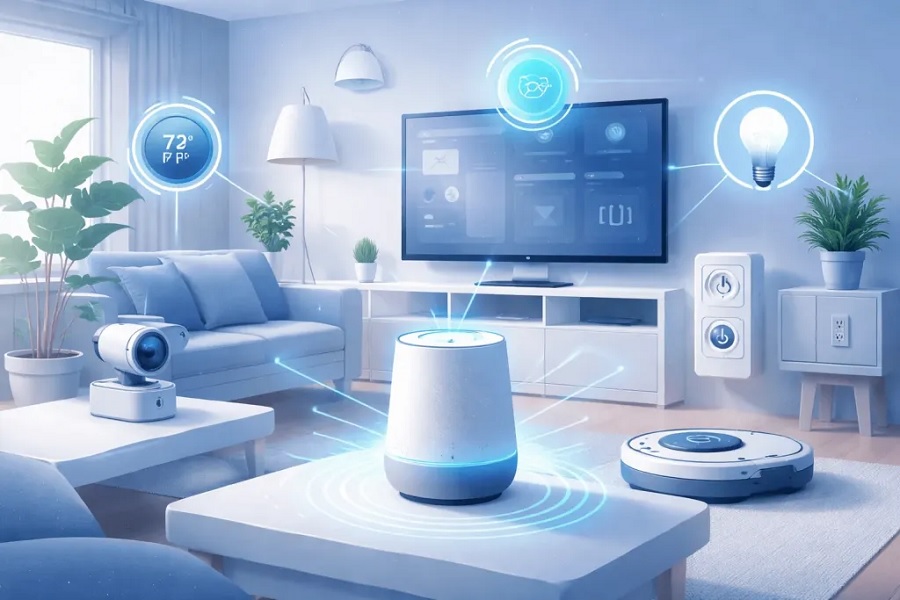
We live in an era where inanimate objects have quietly learned to listen, watch, feel, and react. When a smart thermostat lowers the household temperature twenty minutes before you wake up, or when a fitness tracker detects an irregular heart rhythm during a morning jog, it feels intuitive. Yet, beneath the sleek glass screens and minimalist exterior housings of these everyday gadgets lies an intricate web of invisible technology. This digital awakening is driven entirely by sensors.
Often conceptualized as the sense organs of the digital world, sensors bridge the physical and virtual realms. They translate tangible environmental phenomena like temperature, pressure, motion, light, and chemical composition into electrical signals that microprocessors can interpret and act upon. Without them, smart devices would remain nothing more than passive plastic shells, incapable of contextual awareness or autonomous decision-making. Exploring the mechanics, classifications, and systemic impact of these components reveals how deeply they shape modern connected hardware ecosystems.
Translating the Physical World into Digital Data
At its core, a sensor is a sophisticated transducer designed to detect specific physical inputs and convert them into measurable outputs. This process sounds simple on paper, but executing it accurately within compact, battery-powered hardware requires staggering engineering precision. Whether measuring the slight rotational tilt of a smartphone or tracking parts-per-million air quality in a smart office building, sensors must operate reliably across fluctuating environmental conditions.
The transformation begins when a physical property interacts with the sensing element. For instance, a piezoelectric pressure sensor experiences microscopic mechanical stress when exposed to fluid force, altering its internal electrical charge. That voltage shift is then amplified, digitized by an analog-to-digital converter, and fed into the device central processing unit. Within milliseconds, software algorithms process the data, triggering a corresponding action, such as adjusting a valve or sending an alert notification to a user phone.
This continuous feedback loop forms the foundation of modern automation. Smart hardware does not simply follow a rigid, pre-programmed script; it reacts dynamically to its surroundings. By constantly sampling reality, sensors allow devices to adapt to shifting human habits and environmental variables without manual intervention.
Categorizing the Sensory Spectrum in Connected Hardware
To understand how smart systems achieve such versatile functionality, it helps to examine the diverse families of sensors embedded within them. Each class targets specific physical dimensions, giving hardware distinct capabilities.
Environmental and Meteorological Sensors
Environmental sensors monitor the physical conditions surrounding a device. Temperature sensors, humidity monitors, and barometric pressure gauges allow smart HVAC systems to optimize indoor climates with surgical precision. In industrial internet of things deployments, these same sensors track equipment heat signatures to predict mechanical failures before they result in catastrophic downtime.
Motion and Inertial Measurement Units
Inertial measurement units combine accelerometers, gyroscopes, and magnetometers to track movement, orientation, and velocity in three-dimensional space. These tiny silicon components are the unsung heroes behind mobile device screen rotation, augmented reality headset tracking, and vehicle collision detection systems. They register everything from the subtle flick of a wrist checking a smart watch to the violent deceleration of an automobile airbag deployment.
Optical and Proximity Sensors
Optical sensors capture light data, ranging from basic ambient light meters that automatically dim smartphone displays in dark rooms to sophisticated high-resolution image sensors powering smart security cameras. Proximity sensors work in tandem by emitting infrared or ultrasonic pulses to detect the presence of nearby objects without physical contact, commonly utilized in touchless bathroom fixtures and smartphone face recognition modules.
Powering the Internet of Things Ecosystem
While individual smart gadgets benefit immensely from onboard sensors, their true power emerges when integrated into larger connected hardware ecosystems. The internet of things relies on distributed sensor networks to gather vast quantities of real-time data from disparate locations, aggregating that information in cloud platforms for deep analysis.
Consider a smart agricultural operation. Soil moisture sensors scattered across thousands of acres monitor hydration levels at root depth. Weather stations track local precipitation and wind speed, while optical sensors evaluate crop canopy health. This data flows wirelessly to a central gateway, which automatically activates irrigation pumps precisely where water is needed, conserving resources while maximizing crop yields.
This level of operational coordination is entirely dependent on sensor reliability. If a single node in the network fails or delivers inaccurate readings, the automated chain reaction breaks down. Consequently, hardware engineers invest heavily in making sensors more durable, energy-efficient, and self-calibrating.
Overcoming Engineering Hurdles in Sensor Design
Designing next-generation sensors involves navigating a relentless series of physical and computational compromises. Engineers must constantly balance sensitivity, power consumption, physical footprint, and manufacturing cost.
Energy Harvesting and Ultra-Low Power Consumption
Many connected devices, particularly those deployed in remote structural monitoring or wearable health technology, rely on small batteries or ambient energy harvesting techniques like solar and kinetic generation. Because continuous sensing can drain power rapidly, manufacturers employ clever duty-cycling strategies. The device remains in a low-power sleep state, relying on a low-energy interrupt sensor—such as a basic motion trigger—to wake up the primary processing systems only when significant data changes occur.
Mitigating Environmental Noise and Drift
Sensors do not operate in a vacuum. Electromagnetic interference, physical vibration, and component aging over time can introduce errors, known as sensor drift, into the data stream. Modern hardware counters this through sophisticated onboard firmware filtering. Using algorithms like Kalman filters, the device processor continuously cross-references multiple sensor inputs to smooth out erratic anomalies, ensuring that the final output remains remarkably accurate even in harsh or unpredictable operating environments.
The Future of Ambient Intelligence
As manufacturing techniques advance, sensors are becoming smaller, cheaper, and vastly more intelligent. The integration of edge computing allows modern sensors to process raw data locally on the chip rather than transmitting every single data point to a distant cloud server. This edge-processing capability reduces latency, preserves network bandwidth, and enhances user privacy by keeping sensitive data on the local device.
Ultimately, the evolution of sensors dictates the evolution of smart hardware. As these components grow more perceptive and integrated, the boundary between the physical and digital worlds continues to dissolve. We are moving toward a future of ambient intelligence, where technology anticipates our needs, protects our infrastructure, and interacts with our environment invisibly, seamlessly, and intelligently.